LONDON (Reuters) – Total bank lending in Britain is set to shrink for the first time since 2009 this year, and the lack of credit from mainstream banks will help payday loan firms grow further, a survey by the Ernst & Young ITEM club said on Monday.
The E&Y ITEM club forecast that total UK bank loans would shrink by 2.2 percent in 2012, having risen by an estimated 4.3 percent in 2011.
“We have been warning about the impact bank deleveraging could have on the economy for some time, but this is the first time there will be an annual contraction in total loans since 2009, when the UK economy was still suffering from the immediate effects of the global financial crisis,” said Neil Blake, senior economic adviser to the Ernst & Young ITEM Club.
Last year, Britain’s top banks, including the “Big Four” of Barclays, HSBC and part-nationalised lenders Lloyds and Royal Bank of Scotland, stuck a deal with the government in which they pledged to lend more to businesses in return for legislative restraint.
However, many small firms have said they are still not getting enough credit following the deal, known as “Project Merlin.”
As a result, both small businesses and consumers are turning increasingly to alternative lenders, such as firms that typically lend a few hundred pounds to clients for a week or two to tide them over until their next pay cheque.
Last month, payday loan companies Ferratum and Cash Converters both told Reuters they expected more growth this year, and the E&Y ITEM club said this sector was set to expand in 2012.
“Households that fall outside of the credit terms of traditional lenders are increasingly looking toward other credit providers, regardless of the cost. With banks expected to further tighten lending conditions, we expect the shift towards alternative lenders to continue unabated,” said Blake.
(Reporting by Sudip Kar-Gupta; Editing by Will Waterman)
http://tourism9.cm/ http://vkins.com/
2012年2月6日星期一

2012年1月9日星期一
For euro zone, the heat is on again
BERLIN (Reuters) – The euro zone crisis seemed to vanish from the headlines for a brief moment as 2011 ticked over into 2012, but it is about to return with a vengeance.
The coming months will be decisive in determining whether European leaders can hold their increasingly fragile currency bloc together or will stumble in the face of a daunting set of political, economic and financial obstacles lined up in their path at the start of the new year.
In Greece, where the crisis started over two years ago, the government is in a race against time to agree a bond-swap deal with banks that is crucial to a new 130 billion euro bailout package from European partners and the International Monetary Fund (IMF).
Without that package, Athens faces the threat of a debt default in March.
But talks with the banks and investment funds that are being asked to accept 50 percent losses on their Greek bonds to help pay for the bailout have dragged on for weeks, sowing doubts about whether Athens can really deliver.
“The risk of a disorderly Greek default is once again on the rise, with the threat of contagion to Italy and others,” economists at Barclays Capital said last week.
Compounding the challenge, both Greece and France face elections within months that could complicate decision-making at the national level in two key states and thwart the broader bloc’s ability to act swiftly at a time when pressure is high to bed down agreements sealed at an EU summit last month.
A key element of the summit package was a deal to funnel 200 billion euros to the IMF, money that could be used to offer precautionary credit programmes to Italy and possibly Spain.
But the euro zone is struggling to get the 50 billion euros it needs from nations outside the currency bloc to meet its goal. A senior German official told Reuters on condition of anonymity that securing the participation of Britain, which has shown no inclination to contribute, was absolutely crucial.
Even if those funds are secured, neither Italy nor Spain have shown any willingness to accept aid — and the stigma and greater fiscal oversight that would come with it.
Italian 10-year bond yields have pushed back above the 7 percent mark over the past week, approaching record euro-era highs, and both Rome and Madrid must sell bonds this week in the first major market tests of 2012 for the euro zone’s third and fourth biggest economies.
END OF MERKOZY
The Greek election, expected by the end of March, seems unlikely to produce an outright winner, meaning coalition talks could drag out and prolong uncertainty.
In France, polls suggest there is a good chance President Nicolas Sarkozy, who has steered Europe‘s crisis response along with German Chancellor Angela Merkel, could be pushed out of office by his Socialist challenger Francois Hollande.
While Merkel and Sarkozy have polar-opposite temperaments and clashed frequently when the Frenchman first took power in 2007, they are both conservatives, born just half a year apart, and have developed an effective, even close, partnership after years of high-pressure crisis summits.
And after years of frustration with the French president’s shoot-from-the-hip style, government officials in Berlin say they are now worried about the end of “Merkozy”, the most important relationship in Europe, in the middle of the crisis.
A cut in France’s triple-A credit rating in the weeks ahead could also upset the delicate Franco-German balance, although some economists believe it could force the French to accept more far-reaching fiscal reforms, regardless of who wins the two-round election in April and May.
“It won’t be Merkozy anymore. It will be Angela Merkel and (IMF chief) Christine Lagarde dictating policy in Europe,” said French economist Jacques Delpla.
“The next French president, whether its Hollande or Sarkozy, won’t have many options. The deficit will need to be cut, taxes increased and spending cut.”
RECESSION RISK
Fittingly, Merkel and Sarkozy kick off 2012 with a Monday meeting in Berlin to prepare an EU summit scheduled for January 30 that is expected to focus on efforts to boost growth.
That is perhaps the biggest challenge of all for the bloc. After several years of fiscal consolidation to push down debts and deficits swollen by the global financial crisis of 2008/09, the euro zone is headed for recession — a factor that has pushed the euro down to 16-month lows against the dollar.
Even the bloc’s economic powerhouse Germany is at risk of recession. Greece is entering its fifth straight year of contraction, with no hope of paying down its massive debt.
But restoring market confidence in the finances of struggling euro area countries and getting their economies working again seem like contradictory goals at this point.
“In the current market environment there is no room for using a Keynesian-type expansionary fiscal policy to boost demand in countries with low growth – the markets will simply not accept such a strategy,” Deutsche Bank said in a confidential note on the crisis prepared for the German government late last year.
One bright spot is the European Central Bank (ECB), which is showing greater flexibility under its new President Mario Draghi, euro zone officials say.
The ECB’s decision last month to provide cheap long-term loans to banks has helped assuage fears about the financial sector and could support sovereign debt sales going forward.
“We’re already seeing that Draghi is more flexible than Trichet,” the senior German official said, referring to the Italian’s French predecessor Jean-Claude Trichet. “He won’t put a bazooka in the window for everyone to see but he’ll do what it takes.”
The big question is whether this buys Europe’s leaders the time they need to overcome the formidable challenges they face in the new year.
(Reporting by Noah Barkin; Editing by Rosalind Russell)
http://tourism9.com/
2012年1月3日星期二
Travel chaos as storms lash Britain
Fierce storms have battered Britain with heavy rain and winds gusting over 100mph.
The latest round of unsettled weather added more misery to the January blues as people returned to work after the Christmas and New Year holidays.
Around the country trees fell onto railway tracks and power lines, lorries toppled over on busy roads and local authorities issued flood warnings after rivers swelled.
High seas caused the Port of Dover to close, gusts of wind damaged the roof to a stand at Epsom Downs Racecourse and a power surge led to a washing machine catching fire in Wales.
Commuters faced travel chaos as the bad weather meant some East Coast main line trains between London and Scotland had to start and terminate at Newcastle upon Tyne.
Gemma Plumb, a forecaster from Meteogroup, the weather division of the Press Association, said: “Everywhere has seen strong winds today. So far we’ve seen gusts across central and southern parts of Scotland of 85 to 97mph. That’s an hourly figure, so there’s a chance there may have been stronger gusts of more than 100mph.”
Figures published by the Met Office reported wind speeds of 106mph at Great Dun Fell in the north Pennines and 102mph in Edinburgh.
A bus driver had to be freed after a large tree fell on his vehicle, trapping him inside in Witley, Surrey. The single-decker Stagecoach bus was in Petworth Road when the oak tree, measuring 6ft across, fell on to it at about 8.25am.
A Surrey Police spokesman said: “It is believed that the driver, who was freed by fire crews, has suffered serious injuries and he is being taken to St George’s Hospital in Tooting. There was only one passenger on board the bus at the time of the incident, who escaped uninjured.”
In the South West, the Environment Agency has “yellow” flood alerts active on 21 rivers from Cornwall to Wiltshire. The Tamar Bridge, which spans the river between Devon and Cornwall, has been closed to high-sided vehicles because of strong winds.
http://tourism9.com/
2012年1月2日星期一
As chances for bank loans shrink, Britain’s small firms struggle
Reporting from Redhill, England—
It’s as if someone is “holding your throat and choking you slowly.”
That’s how one analyst vividly describes the squeeze on lending in Europe these days. Scared by the euro debt crisis and a flat-lining economy, banks have been tightfisted with their money, refusing to issue many of the loans that companies desperately need to keep their operations running smoothly or to take them to the next level.
That has added to concern that the world may be heading for another credit crunch hard on the heels of the last one, which was triggered by the 2008 financial crisis and helped tip the global economy into recession.
Here in Britain, Prime Minister David Cameron’s office reckons that banks have already entered a second ice age. In other parts of Europe, especially the weakest of the 17 nations that share the euro, credit has also begun freezing up, analysts say.
The squeeze has sent businesses scrambling for new ways to finance their activities and fostered an alternative market that bypasses Britain’s big “high street” banks in favor of lending houses and venture capitalists.
Among the innovators is the online lending site Funding Circle, which is sort of an EBay of commercial lending. Creditors specify the amount they’re willing to put up, and at what interest rate, in a loan auction for companies in need of the money. The overall loan is pieced together from the best bids, sometimes dozens of them, many of which are submitted by individuals who invest as little as $30.
After little more than a year in operation, Funding Circle facilitated loans worth more than $5 million in November, including $1.6 million within a single week. Businesses usually receive the money within a couple of weeks, compared with the three to six months it can take a bank to process an application.
“We knew that small businesses, even good-quality small businesses, would be underserved” by mainstream financial institutions, said Andrew Mullinger, one of the website’s founders. “They don’t have the clout of the big companies and couldn’t demand services.”
Gerard Oates’ company, Arcadia, sells bulbs and fittings for aquariums and vivariums. Not long ago, he hit on a bright idea for a lamp using cutting-edge technology, which he shopped around to various banks for the financing to develop it.
Every one rebuffed him.
“We needed money, and it wasn’t there,” Oates said, recalling the frustration of repeated rejections. “We had all these product ideas and not the wherewithal to realize them.”
He was “absolutely in shock” when he discovered that he could draw his $118,000 loan less than a week after his request appeared on Funding Circle.
Arcadia’s new 30-watt lamp debuted in December to better-than-expected sales, and is on track to become “the most successful product we’ve ever had,” Oates said.
But plenty of companies haven’t been so lucky in their quest for financing. And in a worrisome sign, many of Europe’s banks have curtailed lending not just to private companies and individuals but to each other, constricting the flow of money that lubricates market economies and keeps them humming.
Last month, the European Central Bank surprised many economists with its announcement that it would be doling out a record amount of money in special low-interest three-year loans to the region’s struggling financial institutions. More than 500 banks signed up to borrow a staggering $640 billion, evidence that many are having trouble drumming up cash.
The hope is that they’ll hand out some of their new funds from the ECB as commercial loans and buy up bonds of financially troubled nations such as Italy and Spain. But economists say it’s also likely that many banks will hoard the extra money to beef up their reserves in the event of an emergency.
That would be bad news for business owners whose own reserves are running low and who need the banks to help tide them over, for example, shopkeepers who traditionally require a boost through lean winter months.
“There were savings that were accumulated over time which were able to fill in for some of the loss of access to credit,” said Sony Kapoor of the think tank Re-Define.
But with those savings close to tapped out, “we are going to see a very serious problem,” Kapoor said. “We’re going to see a contraction of the exact part of the economy — small and medium-sized enterprises — that are most useful to generating growth.”
http://tourism9.com/
George Osborne’s airport hint has Thames estuary in a spin
Dan Milmo and
Patrick Collinson
Patrick Collinson
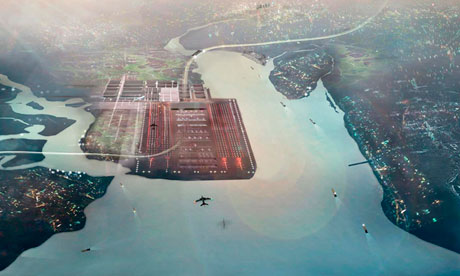
The Thames hub as envisaged by Norman Foster’s design company. Photograph: Foster & Partners/PA
There is a geometric beauty to the view from Kent’s Isle of Grain, as alignments of mudflat, estuary and sky dominate a horizon that, in the wake of this week’s autumn statement, could soon be scarred by dozens of airliners in the cause of economic prosperity.
George Osborne dropped the clearest hint yet that the government is warming to the notion of an airport on the Thames estuary, possibly built on this peninsula, as he pledged to “explore all options for maintaining the UK’s aviation hub status”. For residents of Grain village, it was confirmation that kickstarting the British economy poses a threat to their homes. “It’s ridiculous,” says Jackie Jones, a housewife and Grain resident of 21 years, walking her two dogs on the shoreline. “The economy has gone downhill so much that something has to happen. But I am not sure that pouring billions of pounds into this is the way forward.”
The chancellor begs to differ. He is sold on the idea that infrastructure investment can boost the UK by providing economic links for business and unlocking cash from British pension funds. He also unveiled a memorandum of understanding with the National Association of Pension Funds and the Pension Protection Fund to invest up to £20bn in projects such as power stations and high-speed rail lines, as well as the four-runway airport that would be built right over a quiet village in north Kent. A national infrastructure plan published this week mentioned 500 projects. All they need now is the money.
The Thames airport, unthinkable even a year ago, is becoming ever more feasible. Boris Johnson has campaigned for a new London hub airport in the face of increasingly weak opposition from the Conservative party. Tuesday saw the government come close to conceding that London’s mayor has given them a get-out from opposing new runways at Heathrow, Gatwick and Stansted.
Johnson’s main lobbyist on a new airport is Daniel Moylan, deputy chairman of Transport for London, which runs the capital’s tubes and buses. He says: “I welcome the fact that the chancellor has said Britain must have a modern hub airport, and confirmed that there will be no expansion at Heathrow. This gives impetus to the search for a new location and the mayor is keen that it should be to the east of London. An urgent debate needs to take place.” Johnson has pushed his own idea of a floating airport – dubbed “Boris Island” – situated opposite Grain and off the Isle of Sheppey.
The renowned architect Lord Foster made an arresting contribution last month with proposals for a £50bn hub on Grain, in a project drawn up by his Foster & Partners, economics consultancy Volterra and planning specialist Halcrow. As well as an airport carrying 150 million passengers a year, it includes a new Thames flood barrier and a high-speed rail line that will connect to the High Speed One and High Speed Two routes. The plans are suitably futuristic but £50bn is a towering bill, dwarfing even the £32bn needed to build the HS2 route from London to Birmingham, Manchester and Leeds. For all the infrastructure headlines in the wake of Osborne’s statement, it was only a sketch of complex planning and funding needs.
There is, however, optimism about funding. Ben Hamer, an executive director at Halcrow, says initial discussions about the project have already taken place with sovereign wealth funds – the investment arms of rich states – and major banks. The issue for Halcrow is getting cross-party political backing. That, in turn, will help secure the seed funding to get the project up and running, followed by the multibillion-pound investment in constructing the site.
“If the government says it would love a Thames hub airport that would be a very strong market signal to investors that the risk of getting this through planning are going to be acceptable,” Hamer says, adding that there has been strong interest from Asia in the project. “They are looking for flagship projects.”
He also says that general interest from the financial sector appeared to be strong, and will be further bolstered by the chancellor’s announcement of a pension-fund-backed infrastructure programme. “We are having discussions with finance houses and we have invested a lot of our own time and energy on preparing the ground for funding.”
One scenario could involve the government taking the financial risk out of building the airport by paying a construction firm an agreed sum, plus costs, to put it together. Underwritten by the state, this would keep the cost of capital low. The asset would be handed over to the state on completion and sold to UK pension funds on a 30-year-lease – rather like High Speed One, the lease for which has been sold for £1.4bn to a Canadian grouping of the investment firm Borealis Infrastructure and the Ontario Teachers’ Pension Plan fund. The new airport owner would pay off its multibillion-pound investment by pocketing the revenues over the ensuing three decades.
The issue with this plan is the involvement of the government at the beginning. In the absence of public money – a fair assumption under current spending constraints – construction of a Thames hub would rely on loans raised from the banking sector. But with beleaguered banks determined to shrink their balance sheets – and warned this week by Bank of England governor Mervyn King to put aside even more capital – the proposal could remain stuck in the mud.
One possible solution lies in the national infrastructure plan. Osborne pledged just £5bn in new government cash for infrastructure projects but indicated that UK pension funds were ripe with untapped financial potential.
“We need to put to work the many billions of pounds that British people save in British pension funds, and get those savings invested in British projects. You could call it British savings for British jobs,” he said in the autumn statement, adding that the government was exploring guarantees and ways of letting city mayors borrow against future tax receipts in an echo of the vast municipally funded works that built Britain’s water, sewerage and road network in the Victorian era, as well as hospitals and schools.
Pension funds, which face the challenge of paying out fixed incomes to retirees when investment returns are at historic lows, like the concept of projects with reliable long-term income streams, such as toll roads and bridges. Airport landing fees and rentals from retail premises and parking could form an attractive income. Last week saw the creation of the Insurers’ Infrastructure Investment Forum, a joint initiative between the Association of British Insurers and the government, whose first task will be to create A-grade “infrastructure bonds” that will be attractive to pension funds.
But relying on pension funds for financing airport construction is still a remote prospect. Richard Abadie, infrastructure partner at PricewaterhouseCoopers, and a one-time Treasury official overseeing public-private partnerships, says: “You have to ask: why isn’t pension fund investment in infrastructure happening already? They don’t believe the returns are high enough, and they don’t want to take construction risk. It’s banks that traditionally take on project finance risk and only after that will pension funds and insurers invest in the long-term cash flow to match their liability profiles. But the banks are under huge pressure to reduce their balance sheets.” He cited RBS’s recent decision to sell £5bn of its project finance loans to Mitsubishi, and new ‘Basel III’ bank capital requirements that will further constrain lending.
An alternative is for Britain to create a state infrastructure bank to channel loans into major projects. It could be structured along the lines of the European Investment Bank or state banks that are behind huge construction projects in Brazil, India, Mexico and some US states.
Until then, Lord Foster’s island airport may remain on the drawing board. Decades ago, the original estuary airport project was opposite Grain, on the north bank of the Thames at Maplin Sands. It was conceived in the boom years of the early 1970s, and in 1973 an act paving the way for construction was passed in parliament. But the project was one of the earliest casualties of the 1973-4 oil crisis and subsequent recession. As a new credit crunch beckons, proponents of the scheme will be hoping that history does not repeat itself – although the residents of Grain will not agree.
http://tourism9.com/George Osborne dropped the clearest hint yet that the government is warming to the notion of an airport on the Thames estuary, possibly built on this peninsula, as he pledged to “explore all options for maintaining the UK’s aviation hub status”. For residents of Grain village, it was confirmation that kickstarting the British economy poses a threat to their homes. “It’s ridiculous,” says Jackie Jones, a housewife and Grain resident of 21 years, walking her two dogs on the shoreline. “The economy has gone downhill so much that something has to happen. But I am not sure that pouring billions of pounds into this is the way forward.”
The chancellor begs to differ. He is sold on the idea that infrastructure investment can boost the UK by providing economic links for business and unlocking cash from British pension funds. He also unveiled a memorandum of understanding with the National Association of Pension Funds and the Pension Protection Fund to invest up to £20bn in projects such as power stations and high-speed rail lines, as well as the four-runway airport that would be built right over a quiet village in north Kent. A national infrastructure plan published this week mentioned 500 projects. All they need now is the money.
The Thames airport, unthinkable even a year ago, is becoming ever more feasible. Boris Johnson has campaigned for a new London hub airport in the face of increasingly weak opposition from the Conservative party. Tuesday saw the government come close to conceding that London’s mayor has given them a get-out from opposing new runways at Heathrow, Gatwick and Stansted.
Johnson’s main lobbyist on a new airport is Daniel Moylan, deputy chairman of Transport for London, which runs the capital’s tubes and buses. He says: “I welcome the fact that the chancellor has said Britain must have a modern hub airport, and confirmed that there will be no expansion at Heathrow. This gives impetus to the search for a new location and the mayor is keen that it should be to the east of London. An urgent debate needs to take place.” Johnson has pushed his own idea of a floating airport – dubbed “Boris Island” – situated opposite Grain and off the Isle of Sheppey.
The renowned architect Lord Foster made an arresting contribution last month with proposals for a £50bn hub on Grain, in a project drawn up by his Foster & Partners, economics consultancy Volterra and planning specialist Halcrow. As well as an airport carrying 150 million passengers a year, it includes a new Thames flood barrier and a high-speed rail line that will connect to the High Speed One and High Speed Two routes. The plans are suitably futuristic but £50bn is a towering bill, dwarfing even the £32bn needed to build the HS2 route from London to Birmingham, Manchester and Leeds. For all the infrastructure headlines in the wake of Osborne’s statement, it was only a sketch of complex planning and funding needs.
There is, however, optimism about funding. Ben Hamer, an executive director at Halcrow, says initial discussions about the project have already taken place with sovereign wealth funds – the investment arms of rich states – and major banks. The issue for Halcrow is getting cross-party political backing. That, in turn, will help secure the seed funding to get the project up and running, followed by the multibillion-pound investment in constructing the site.
“If the government says it would love a Thames hub airport that would be a very strong market signal to investors that the risk of getting this through planning are going to be acceptable,” Hamer says, adding that there has been strong interest from Asia in the project. “They are looking for flagship projects.”
He also says that general interest from the financial sector appeared to be strong, and will be further bolstered by the chancellor’s announcement of a pension-fund-backed infrastructure programme. “We are having discussions with finance houses and we have invested a lot of our own time and energy on preparing the ground for funding.”
One scenario could involve the government taking the financial risk out of building the airport by paying a construction firm an agreed sum, plus costs, to put it together. Underwritten by the state, this would keep the cost of capital low. The asset would be handed over to the state on completion and sold to UK pension funds on a 30-year-lease – rather like High Speed One, the lease for which has been sold for £1.4bn to a Canadian grouping of the investment firm Borealis Infrastructure and the Ontario Teachers’ Pension Plan fund. The new airport owner would pay off its multibillion-pound investment by pocketing the revenues over the ensuing three decades.
The issue with this plan is the involvement of the government at the beginning. In the absence of public money – a fair assumption under current spending constraints – construction of a Thames hub would rely on loans raised from the banking sector. But with beleaguered banks determined to shrink their balance sheets – and warned this week by Bank of England governor Mervyn King to put aside even more capital – the proposal could remain stuck in the mud.
One possible solution lies in the national infrastructure plan. Osborne pledged just £5bn in new government cash for infrastructure projects but indicated that UK pension funds were ripe with untapped financial potential.
“We need to put to work the many billions of pounds that British people save in British pension funds, and get those savings invested in British projects. You could call it British savings for British jobs,” he said in the autumn statement, adding that the government was exploring guarantees and ways of letting city mayors borrow against future tax receipts in an echo of the vast municipally funded works that built Britain’s water, sewerage and road network in the Victorian era, as well as hospitals and schools.
Pension funds, which face the challenge of paying out fixed incomes to retirees when investment returns are at historic lows, like the concept of projects with reliable long-term income streams, such as toll roads and bridges. Airport landing fees and rentals from retail premises and parking could form an attractive income. Last week saw the creation of the Insurers’ Infrastructure Investment Forum, a joint initiative between the Association of British Insurers and the government, whose first task will be to create A-grade “infrastructure bonds” that will be attractive to pension funds.
But relying on pension funds for financing airport construction is still a remote prospect. Richard Abadie, infrastructure partner at PricewaterhouseCoopers, and a one-time Treasury official overseeing public-private partnerships, says: “You have to ask: why isn’t pension fund investment in infrastructure happening already? They don’t believe the returns are high enough, and they don’t want to take construction risk. It’s banks that traditionally take on project finance risk and only after that will pension funds and insurers invest in the long-term cash flow to match their liability profiles. But the banks are under huge pressure to reduce their balance sheets.” He cited RBS’s recent decision to sell £5bn of its project finance loans to Mitsubishi, and new ‘Basel III’ bank capital requirements that will further constrain lending.
An alternative is for Britain to create a state infrastructure bank to channel loans into major projects. It could be structured along the lines of the European Investment Bank or state banks that are behind huge construction projects in Brazil, India, Mexico and some US states.
Until then, Lord Foster’s island airport may remain on the drawing board. Decades ago, the original estuary airport project was opposite Grain, on the north bank of the Thames at Maplin Sands. It was conceived in the boom years of the early 1970s, and in 1973 an act paving the way for construction was passed in parliament. But the project was one of the earliest casualties of the 1973-4 oil crisis and subsequent recession. As a new credit crunch beckons, proponents of the scheme will be hoping that history does not repeat itself – although the residents of Grain will not agree.
2011年12月29日星期四
Olympics, Titanic, Cuba shape travel in 2012
NEW YORK — The Olympics, the centennial of the Titanic sinking, new rules on travel to Cuba, a once-a-decade horticultural festival in the Netherlands and a continued reliance on technology and personalization will all help shape travel in 2012.
Here are some details on these and other destinations and trends.
EVENTS: The Summer Olympic Games take place in London, July 27-Aug. 12. For those without tickets, Hyde Park and other places will host live broadcasts of the games on giant outdoor screens. A three-month arts festival beginning June 21 will add a cultural component, from Shakespeare to music to street performers.
Great Britain will also celebrate Queen Elizabeth’s Diamond Jubilee June 2-5. She is only the second British monarch after Queen Victoria to mark 60 years on the throne.
The Netherlands is planning Floriade, a horticultural expo that takes place once a decade. A 160-acre park with five different floral and nature themes opens April 5-Oct. 7, in Venlo, about 85 miles or two hours by train from Amsterdam; http://www.floriade.com.
The European Capitals of Culture for 2012 are Maribor, Slovenia, known for wines, a historic town center and nearby forests, waterfalls and moors; and Guimaraes, Portugal, known for crafts like goldsmithing, pottery and embroidery, and for its roots as the birthplace of Portugal’s first king, who established the country as an independent kingdom from Spain. Arabella Bowen, executive director of editorial and content strategy at the travel guidebook publisher Fodor’s, says both destinations are great values for food and hotels, with interesting attractions away from the crowds.
In the U.S., the bicentennial of the War of 1812 will be marked with tall ships, educational events and fireworks in several destinations, including June 6-12 in Norfolk, Va., and June 13-19 in Baltimore’s Inner Harbor and the Chesapeake Bay.
TITANIC 100TH: The Titanic hit an iceberg and sank April 15, 1912, on its maiden voyage from England to New York. A variety of events in 2012 — including some cruises — will mark 100 years since the tragedy in which more than 1,500 died. Halifax, Nova Scotia’s Maritime Museum of the Atlantic offers an extensive permanent Titanic exhibit but will also be hosting special exhibits and events for the April anniversary and into the summer. Visitors can also tour Halifax’s Fairview Lawn Cemetery, where 121 Titanic victims are buried.
The Titanic was built in Belfast, Ireland, and an enormous waterfront development called Titanic Quarter is taking shape on the site of the former shipyard, with hotels, eateries, parks, theaters and galleries. Titanic Belfast, an ultra-modern building whose shape and silvery color evokes ship hulls on the water, is set to open in April with Titanic-themed galleries and interactive exhibits. Southampton, England, which lost 549 locals when the ship went down, mostly crew members, is also opening a new interactive museum, Sea City, focusing on various aspects of the Titanic story.
Far from those ports, the Titanic Pigeon Forge attraction in Tennessee is a half-scale, three-deck reproduction of the ship. A centennial tribute “Night to Remember” is planned for April 14.
DESTINATIONS: For “up and coming” destinations for 2012, Croatia, Vietnam and Panama were named in an annual survey of 640 travel agents and owners from Travel Leaders. For top 10 international destinations based on 2012 booking data, the Travel Leaders survey listed Caribbean cruises; Cancún, Mexico; Playa del Carmen, Mexico; Mediterranean cruises; Rome; London; Punta Cana, Dominican Republic; Paris; Montego Bay and Negril, Jamaica.
Fodor’s Bowen put Cuba on her list of top destinations for 2012. U.S. citizens can now travel to Cuba legally even if they don’t have relatives there under new U.S. State Department regulations permitting certain types of trips. “Everyone wants to get in to see the country before everything changes,” said Bowen.
Interest in Myanmar is also increasing. Secretary of State Hillary Rodham Clinton recently visited, and an organization founded by activist Aung San Suu Kyi said it welcomes responsible tourism. Abercrombie & Kent has filled several tours and just added another departure for fall 2012.
NORTHERN LIGHTS: The aurora borealis or northern lights, those mysterious curtains of color seen in Northern Hemisphere skies, are caused by a cycle of magnetic activity on the sun. The cycle lasts about 11 years, and experts say a period of low activity is ending.
Some folks are predicting this will be a banner year for northern lights. The University of Alaska’s Geophysical Institute, which publishes auroral forecasts at http://www.gi.alaska.edu/AuroraForecast, doesn’t necessarily foresee peak viewing in 2012, but agrees that we are entering a period of “increasing solar activity” with “more active, colorful aurora during the normal viewing season,” late August to late April (when there’s less daylight than during summer).
TECHNOLOGY: The smartphone has become the must-have tool for travel, offering GPS navigation, online bookings, scannable check-ins, and QR codes and locaters with information geared to wherever you are.
Ad agency JWT’s travel trend list for 2012 mentions apps like Uber, a cab-dispatching service; Postagram, which turns snapshots into postcards; and Vocre, an app that translates spoken words into other languages.
But never mind crowd-sourcing from websites where phony reviews and picky consumers make it hard to figure out the real deal. Instead, travelers are friend-sourcing, with sites like Trippy.com showing recommendations from your social networks. Another new app, Wenzani, takes content from guidebook publishers Lonely Planet, Frommer’s and DK and integrates it with advice from your friends and social networks.
ELECTION AND ECONOMY: Do presidential elections affect travel? A recent survey found 75 percent of U.S. Tour Operators Association members believe travel decreases in election years. Respondents said uncertainty and negative rhetoric keeps people home.
Still, 75 percent of USTOA members anticipate a growth in sales in 2012 as the economy improves. Eighty percent of agents and owners at Travel Leaders also said bookings for 2012 are so far equal to or higher than 2011.
This article is from http://tourism9.com/
订阅:
博文 (Atom)